A Note on Method
Three reading decisions run through every chapter, and the reader deserves them up front.
First: the characters are read as the eye meets them on the page. Where 強 shows a bow (弓), the bow does the teaching—even where philology traces the printed form to an older composition. This is the pictographic method, not an archaeological claim; where the two diverge in a way that matters, the analysis says so in place.
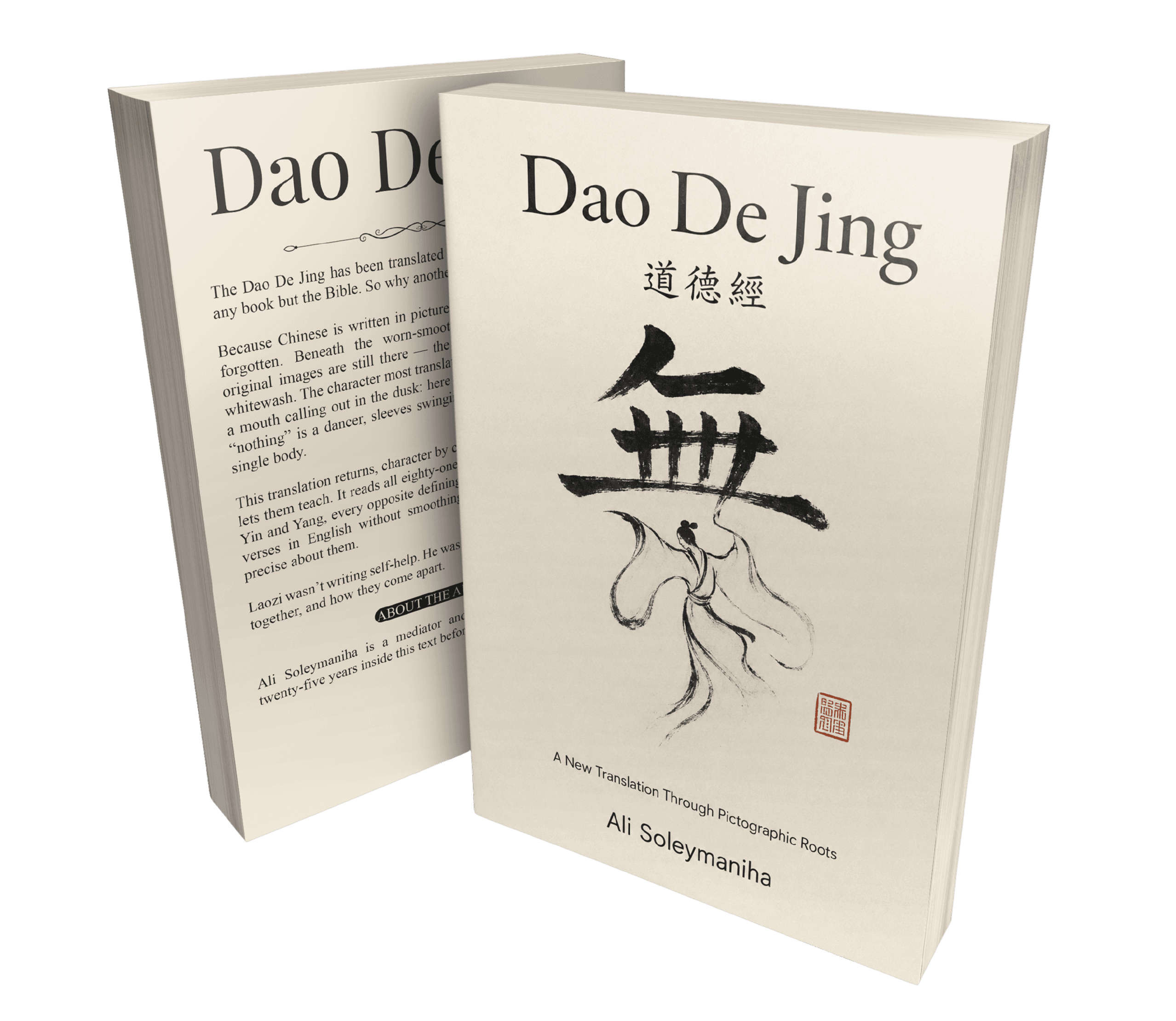
Second: 無. The oracle-bone form behind 無 shows a dancing figure with sleeves and tassels—the same figure that later became 舞, the dance. Conventional translation reads 無 as bare negation: nothing, without. This translation reads it as the unity of Yin and Yang, the wholeness prior to division—and the dancer is no embarrassment to that reading, for the dance is two poles moving as one body. The departure from convention is made knowingly, and for a reason the chapters demonstrate line by line: the negation reading turns precise cosmology into riddles; the unity reading turns the riddles back into cosmology.
Third: 不 is read throughout as the bird soaring within the sky's limits—freedom within natural law—and 無 as unity. But the text itself sometimes marks an impossibility imposed by the nature of things rather than a freedom chosen, and there plain negation is kept: the boaster is stripped of merit, the granary is simply bare. Every such exception is flagged where it occurs, in the character analysis of its own chapter. The departures are decisions, not oversights.
Some readers want to see the machinery — why 無 is a dancer and not a void, how each character earns its English. That reading is here, in full. Others simply want the Dao De Jing in their hands, to read cover to cover without stopping at every root. That is the book: the same work in plainer English, the analysis distilled rather than exhaustive. Neither is the lesser reading. They are two doors into the same text.